
Here in Canada, we talk about the weather. It’s what we talk about when we have nothing else to talk about. Then again we have weather to talk
about. We get snow, hail, rain, sleet, sunshine. Sometimes we get it all
in the same day! Talking about the weather gives us something to say
when we don’t know what else to talk about.
I make light of this but, as a sailor, the weather is super important.
The weather effects almost everything we do on the boat. The wind powers
us forward. It’s what gasoline is to a car. Also, knowing what will
happen with the weather is a matter of our personal safety and the
safety of the boat. If strong winds are coming, we can put up less sail
area–a process known as reefing–so we can control the boat and be
more comfortable. If we are near a good harbour we can go in and be
protected from the wind.
Because weather and more specifically the wind is so important, it’s
very important that we have accurate weather forecasts so we can prepare
for whatever Mother Nature throws at us. Here are the main ways we get
weather information.
The first way is via the internet. When we are near populated areas we
can use our mobile phones to pick up a signal and get the weather.
Environment Canada posts their marine weather forecast several times a
day on their website. It’s quick and easy to check the weather for our
area. In addition to Environment Canada, we use a couple of apps/sites
to analyze the weather. We use Windy and
Predict Wind. The sites are similar but
different enough that we check both. They involve downloading various
computer-generated weather models called
GRIBs. The gribs have information
like predicted wind speed, wave height and wave period. They predict the
weather for as far out as a week or more but like all weather forecasts,
they are most accurate for the first couple of days.
From the internet we also get synoptic weather charts. These are charts
that show the high and low pressure systems which are helpful in
forecasting the weather.
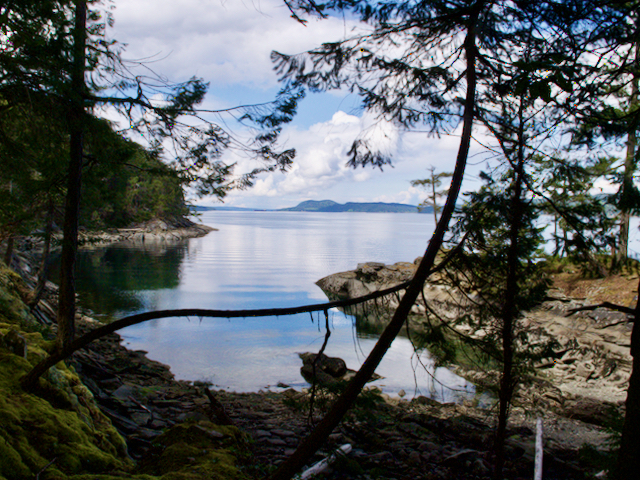
Unfortunately, it’s not easy to get a mobile phone signal along the BC
coast. There is signal near populated areas but once away from them the
signal is spotty. BC’s mountains and deep valleys mean the signal does
not penetrate into much of the coastline. It just so happens that the
places we like to explore–the quiet, secluded places–usually don’t
have cellphone coverage.
Environment Canada broadcasts the marine forecast on VHF radio. This is
our second way of receiving weather forecasts. The Environment Canada
forecast is a looping recorded message that’s updated regularly. They
have several broadcast stations along the coast, so we are able to
receive the weather along much of the coast. Like the internet signal,
the radio signal is hindered by the tall mountains and deep valleys, but
the signal is available in more areas than the mobile phone signal.
In addition to the VHF radio, we have an SSB radio. SSB radios can
transmit and receive over very long distances. We can pick up audio
weather forecasts similar to what is broadcast on the VHF and there is a
way to download weather synoptic charts. We have an SSB radio but we
have yet to use it and it’s not a high priority for us to learn how to
use it–yet. That’s because we plan on using a satellite communication
system.
We plan to purchase and set up the satellite communication equipment
over the next few months. Our current plan is to use the Iridium Go. It
will give us basic internet. It won’t be fast. In fact, it will be very
slow compared to any internet connection we’ve used in recent years.
There will be no Netflix or YouTube but it will give us basic text
messaging, text-based email and most importantly, weather. We’ll be able
to download synoptic weather charts and GRIBS. They will be very
important to us as we plan.
Our satellite system will also be very important to us when we leave
Canada and sail offshore. We will be able to get weather information,
text messages and basic email anywhere we go.
We’ll let you know how it goes when we get it installed.
 Cormacks On Cambria