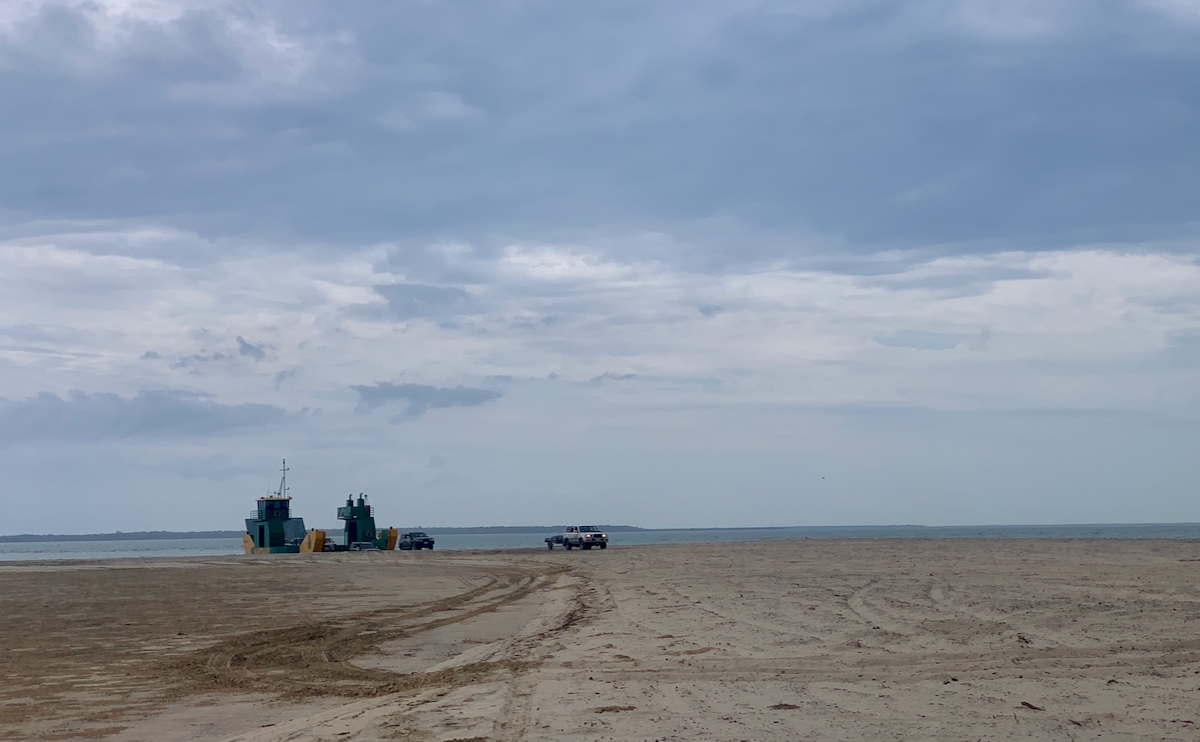
We’ve been surprised by how shallow the waters are off Australia’s east coast. Our introduction to it was the last 40 nautical miles of our passage from Vanuatu. As we made our way into Hervey Bay we crossed from water that was several thousand meters deep to less than 45. Combined with NW winds, it made for a very rolly last night of our passage.
Leaving Bundaberg, making our way south across Hervey Bay and into the Sandy Straights, we rarely saw depths more than 15m.
We’ve had to be careful to find suitable anchorages. Cambria draws about two meters. Tidal swings have been near 1.5 meters so this means we need to do our math carefully to ensure we have enough water under our keel at low tide. Lately we’ve had trouble finding areas with four or five meters of water in which to anchor.
A few nights ago we anchored just south of Inskip Point in Pelican Bay. The anchorage is surrounded by sandbanks with a narrow strip of water deep enough for us to anchor in. There were several boats already anchored when we arrived which limited our options. We dropped anchor behind another monohull in 7.5m of water. We let out our usual 5:1 scope and dug in the anchor. At first it seemed to drag a bit but eventually it set. The weather report didn’t call for strong winds that night so we settled in.
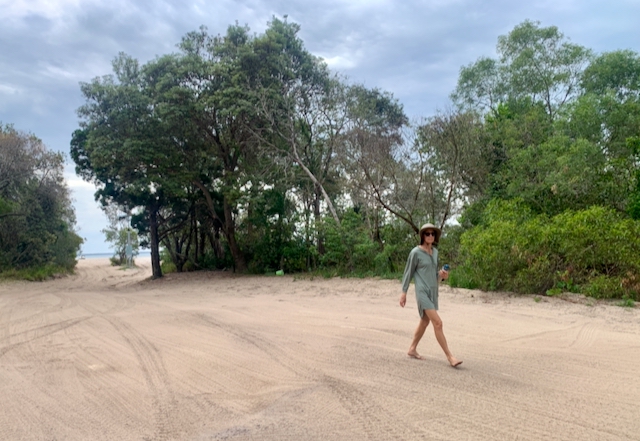
That afternoon we enjoyed a walk on the long sandy spit near the anchorage and then got the dinghy back up on deck ready for an early departure the next morning.
A little after 8 o’clock that evening, we noticed thunderstorms all around us. It was mostly sheet lightening and we could feel the wind freshening but we weren’t concerned. We’ve comfortably been at anchor in storms with winds over 40 kts. The winds were soon over 20 kts. I decided to start the engine so we could motor into the wind if necessary. At this point, things happened fast. The wind that had been from the northwest was now from the south or southeast–a shift of 180°.
By the time the motor was running, we were seeing winds of 30 kts.1 We turned on the chartplotter and instruments. As soon as the depth sounder powered on, we were greeted by its low water alarm. We soon felt Cambria’s keel bouncing on the bottom.
Rain was bucketing down making it near impossible for us to get our bearings. We tried to see past the rain to the anchor lights on the boats around us but it was difficult. Our only illumination was from lightening strikes. Our spotlight proved useless at piercing through the deluge. Instead, the heavy rain reflected its light back into our eyes.
Before the rain, I had been monitoring our position on a nearby can buoy but now its red flashing light was near indiscernible through the heavy rain. As I said before, this all happened very quickly. From feeling the wind freshening, to starting the motor and instruments, to feeling Cambria’s keel bumping the bottom seemed to happen simultaneously. Of course, I have no idea how much time passed. Neither of us stopped to check the time.
We tried to pull ourselves forward with the anchor winch while motoring as hard as we could but we couldn’t get off the sand bar. The boat beside us realized we were in trouble and called us on the VHF. They offered to use their dinghy to pull us off. It was very kind of them to offer but I didn’t think a small inflatable dinghy would have enough power so I said we’d try again with our windlass and engine. We couldn’t get off and soon called our neighbours and accepted their offer of help. Another boat in the anchorage heard us on the radio and came over with their dinghy picking up another cruiser along the way to help.
With two dinghies, our anchor winch and our motor at full throttle Cambria wouldn’t budge. We changed strategies and attached our main halyard to one of the dinghies and pulled in an attempt to lean the boat sideways freeing up the keel. Our efforts were in vain. The tide was dropping too fast. We were stuck. We weren’t going anywhere until the tide rose. We thanked those that had come to help and got ready for a long night.
At this point we were still three hours away from low tide so we made preparations for what was to come. We closed all the through hulls. I checked that we hadn’t sucked any sand into the engine from our efforts to free ourselves, while Sharlene made sure everything was secure and wouldn’t fall over as the boat tipped sideways.
Once we finished our preparations, we propped ourselves up with pillows in the main salon. It was impossible to use our bed. Very quickly Cambria settled on her starboard side. We sat wedged around the salon table listening to Cambria creek as she settled further and further onto her side. We didn’t think to measure how far over we went but we estimate it was about 45°.
For the next few hours I dozed a little but Sharlene didn’t or couldn’t sleep. At 12:30–low tide–I climbed out on deck. I chose to climb to the “high side”. The words of a children’s’ radio show we used to listen to when Brian and Hannah were young, playing through my head. “High side! High side!” I could have jumped ashore to the sandbank without getting my feet wet. I could hear the pelicans squawking nearby. I trained our spotlight on the shore and saw them huddled together. I imagined their squawking was them complaining about our intrusion onto their sandbank.
From then on we steadily felt Cambria becoming upright. By three o’clock we were vertical. I checked the depth but we still didn’t have enough water under the keel to get ourselves free.
By four o’clock the boat’s movements felt different. I checked the depth sounder which read 1.9m of water under us. Tentatively, I went to the bow and tried the anchor winch. We were moving! I pulled us forward about a boat’s length. The depth sounder read 4.5m! That’s how close we’d been to not running aground!
We got the engine running and lifted the anchor in order to reset it. As we were doing this, another squall hit but we managed to get the anchor set without any more drama. As the rain came down and we watched the lightening all around us, we checked our position constantly. Thankfully, this time, the wind was blowing us away from the sandbank.
Before the drama of that night, we had planned for an early start that morning. The plan was to cross the Wide Bay Bar–a notorious stretch of water that we needed to cross at high-slack tide and in favourable conditions. The current squall did not create the conditions we needed. We delayed our departure. Thankfully, after about 45 minutes the wind and rain lightened. We raised our anchor, made our way out of the anchorage and pointed the bow toward Wide Bay Bar.
Wide Bay Bar has a fierce reputation. Boats have been wrecked trying to cross it but after the stresses of the night before, I am happy to report that we crossed over it without incident. An hour or so later, the sun came out and we had a pleasant day making our way further south. On to the next adventure!
- The next day the people on the boat anchored next to us said they had seen a maximum wind speed of 36 kts. ↩︎
 Cormacks On Cambria
wow! Definitely a sleepless night! So glad you were able to “right” the problem! 👍
LikeLiked by 1 person