
In an earlier post I responded to some people that asked what we do at night. I said we sail. That prompted some questions about how we navigate at night. How do we see where we are going?
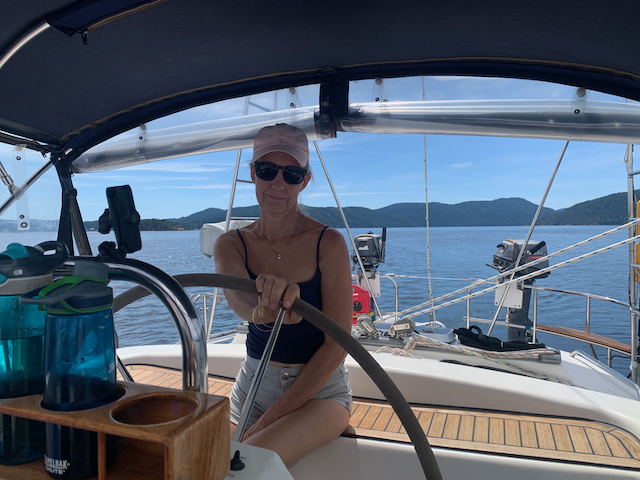
Seeing at night is actually not that hard. It’s amazing how well our eyes pick up and use every bit of available light to help us see. When out at sea there isn’t a lot of other light around to take away our night vision. Also, when out on the open ocean anything with a light on it is probably something we should avoid. Finally, on the open ocean there isn’t a lot of stuff for us to hit.
All boats are required to have lights on them when running at night. The configuration of the lights depends on the type of boat and its size but they are required to have them and use them. Unfortunately, in many parts of the world small boats do not use their running lights. This may be because they can’t afford to equip their boats with lights or because they don’t want to be seen. They may be doing something that they don’t want people to know about.
I remember an overnight passage we did many years ago in the Caribbean. We crossed the Anegada Passage between Anguilla and the British Virgin Islands. The trip was going to take long enough that we couldn’t do it during daylight hours so we had an early dinner and headed off just as the sun was setting. During the night we saw a few large cruise ships. They were light up like huge city buildings so they were easy to spot but at one point we heard an engine running at high speed. We couldn’t see any lights. It sounded quite close but as hard as we tried we couldn’t see a thing. We kept a close watch for quite some time. Eventually the sound faded into the distance.
Sound travels very well over the ocean so it can be very helpful at night. When we’re sailing the boat is usually quite quiet so it’s possible to hear the sound of another boat’s engine. This doesn’t work if we have our engine running or if there’s a strong wind blowing so we can’t rely solely on sound. Thankfully we have two other methods that help us see in the dark–AIS and radar.
AIS stands for Automatic Identification System. AIS transceivers combine information about a boat with course and speed information and broadcast it on radio waves for other boats to pick up with their AIS screens. I won’t go into details on how it works but you can see it in action here. For us, we can see other boats as dots on our iPads or MacBook screens. The software will warn us if we are getting too close to the other boats or if we’re on a collision course!
The challenge with AIS is that not all boats have it. If they don’t have an AIS transceiver on their boat then we won’t see them on our screens. This is where radar fits in.
Radar doesn’t rely on the other boats to have any kind of special equipment. Our radar unit sends out a signal that bounces off other boats and back to our radar. Like AIS, boats appear as dots on our screens. The dots are not as easy to interpret as with AIS but the advantage of radar is that it doesn’t rely on other boats to have any special equipment. Also, it shows everything like nearby islands and rocks, not just other boats.
As you can see there isn’t just one way to see in the dark. The person on watch uses their eyes, ears and some pretty cool technologies to keep us safely sailing at night.
 Cormacks On Cambria
When you get your AIS hooked up I hope to track you guys all over the world. Marine Traffic is a fun app to have
LikeLiked by 1 person
Thanks for explaining how you sail at night! I am wondering where your location is now and how you purchase food. Do you catch fish too? Sorry to ask so many questions. I am so curious and excited to read your updates.
LikeLiked by 1 person
Hi Peggy, Great to hear from you. We are in Canada. We’ll be hear until September but that might have to change. Right now most of the countries we want to go to won’t let boats visit because of Covid. You are much better off in China than most parts of the world right now.
Regarding food, we’ll have to purchase food that will last. We’ll stock up which means lots of dried and canned food. Fishing well… we will fish but I’m not a good fisherman. We will starve if we have to rely on my fishing skills 🙂
Thanks for the questions and please keep them coming!
–Rob
LikeLiked by 1 person
Awesome, you sound more like a professional seaman than a Pre-K2 teacher…. :).
We have the Spring Festival ( CNY, short for Chinese New Year ) here in Malaysia and have been slow in picking up mails. Summer n her mom say ‘hi ‘ to you and wish you both have a wonderful journey. She is still somehow very fond of the life in SIS !
Till then, so long and have fun.
LikeLiked by 1 person
Hi thanks for the post. We are doing lots of boat jobs while we wait for CoVid to settle down. We hope to leave Canada in September and start our journey but we will have to wait and see. Say hi to Summer!
LikeLiked by 1 person