Several years ago I saw a series of MRIs taken of people playing a video game for the first time. Their brains were lit up. The MRIs showed activity across many regions of their brains. Later, their brains were re-imaged after they had played the game multiple times. Their brains were no longer lit up in the same way as they were before. Their brains were no longer as active. They had learned the game and they no longer needed as much of their brain to play it.
When I was young, I thought learning was done in school. From high school I went on to university. From there I worked for a few years before returning to university to complete another degree. I thought that was how learning was done. It’s done in school. It’s done in stages and then it’s finished.
Of course it’s not that way. As an adult I soon learned that learning never ends. As a teacher I tried to model this to my students. One of my favourite concepts is the Lifelong Kindergarten at MIT. The concept there is that learning is not only lifelong but it is also fun, exploratory and active. Learning is lifelong.
Even as I espoused the importance of lifelong learning, I was learning within my field of expertise. My learning was incremental. I think of my learning like our family’s Christmas tree.

Our family has had the same Christmas tree for many years. Each year we pull it out of storage, set it up in the corner of our living room and decorate it. We use the same decorations year after year but sometimes we add some new ones to the mix. Each piece of my learning was like adding a new ornament to my Christmas tree–my knowledge tree. I might add a new ornament or two each year or replace an old string of lights but I was still working on the same tree. My boundaries were well defined. For me my learning was mostly confined to educational technology and learning theory.
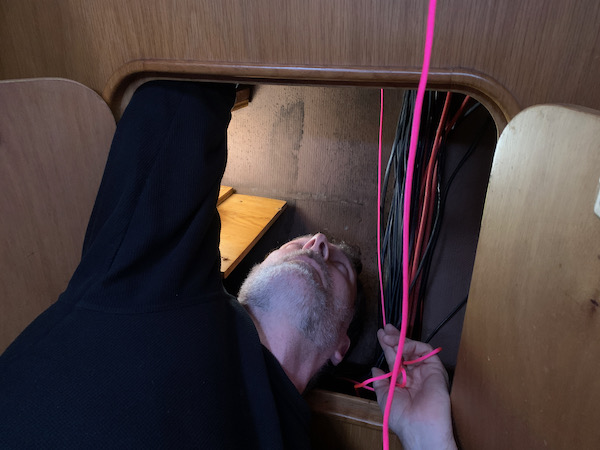
Sailing has changed that. I have been sailing for years so I have a strong understanding of it but I have had to revise, re-learn and learn many things since buying Cambria. Much of my previous understanding was head knowledge. It was theoretical. Now I am building practical skills–hand knowledge. Take electricity for example.
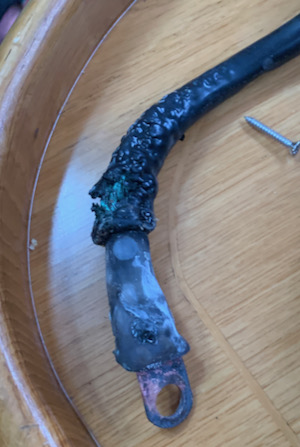
I know the basics of electricity but now I am getting hands-on knowledge. It’s one thing to understand in my head that electrons flow through circuits but it’s quite another thing to actually pull wires through the boat ensuring that they are supported every 45 centimetres and connections are crimped on with heat shrink fittings so as to ensure moisture doesn’t get into them. I know that I need to choose the right gauge wire so that the electrons can flow freely. If I choose a wire that’s too thin, I’ll add resistance to the circuit. Too much resistance and our new electronics won’t work or worse. Resistance causes heat and too much heat can cause a fire.
Sometimes I find myself wishing I could remember my school science classes better or that I’d taken more hands-on classes like wood shop. (I took some shop classes but not enough and it was a long time ago.) I am envious of the trades people that we have work on the boat. They have strong head knowledge combined with practical skills–hand knowledge. I am often amazed at how they identify a problem, devise a solution, pick up some tools and fix the problem.
Thankfully, there are now many more ways to learn the skills I need compared to a few years ago. I spend hours watching YouTube videos learning how to wire circuits or rig sails. The videos are good for building my head knowledge but the practical skills take time and practice to develop. Jobs always take longer than I’d originally estimated they would take and they are never as straight forward as the YouTube videos show.
The bottom line is that learning really is lifelong. Whether it’s head knowledge or hand knowledge, learning never stops. Thankfully, there are lots of ways for us to learn what we need to know, when we need to know it.


Good stuff. A lot of what we learn in the education system is nice to know things, but in all likely hood will never be used. It is mainly teaching us how to think how to over come or undo a problem situation. So, Rob your education continues all be it in the hull of a sail boat. Good on you Sharlene.
LikeLike