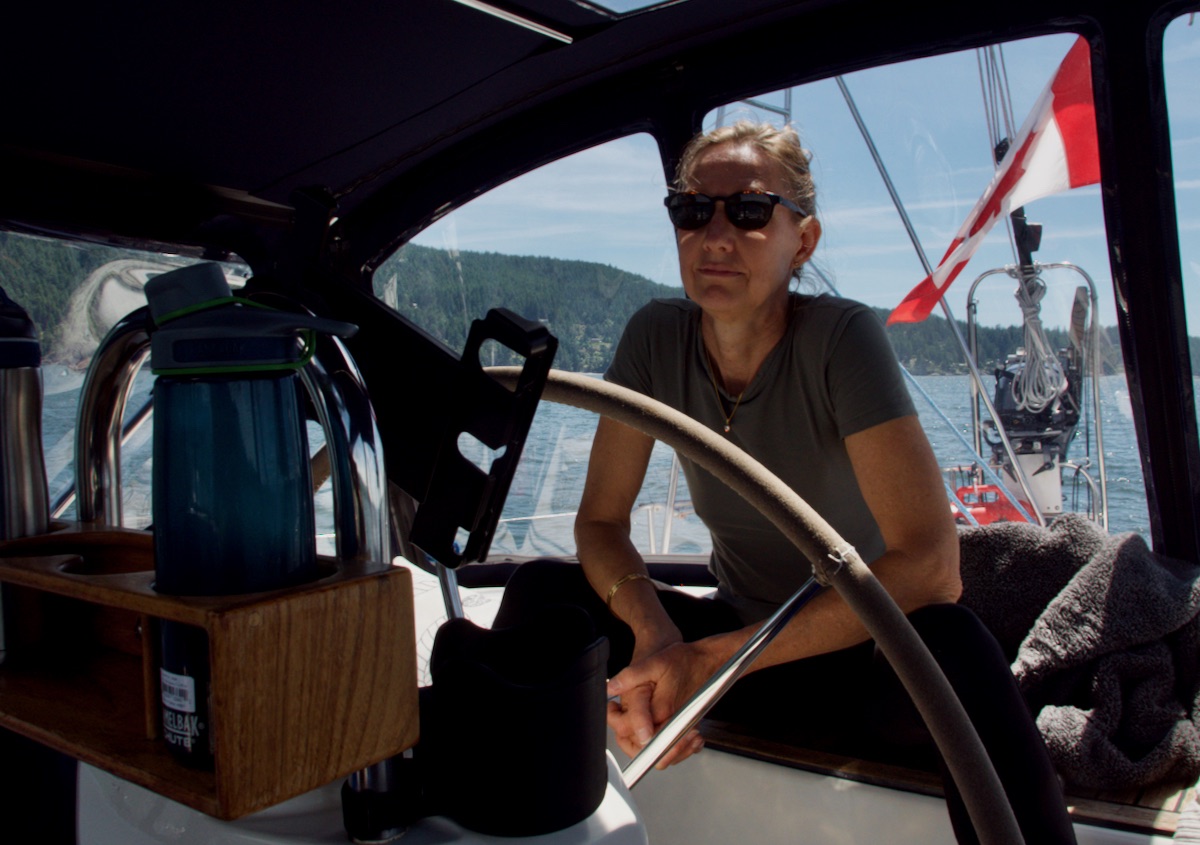
We steer with the steering wheel–right? Well, yes sort of. Cambria has a steering wheel and yes, we use it to steer the boat but actually, I don’t like steering. I find it boring. It’s interesting when we’re entering a harbour, dropping the anchor or manoeuvring into a dock but the rest of the time, it’s boring. Steering a boat is not like driving a car. Sailboats move slowly compared to cars and I find standing at the wheel for hours is tedious. To help alleviate the tedium, we have two self-steering systems on Cambria–an autopilot and a windvane.
The autopilot is quite straight forward. We point the boat to where we want to go, press a button and the autopilot steers the boat in a straight line. If the wind changes or pushes us off course the autopilot turns the boat back on course. Simple, right? It uses an electric motor that attaches to our rudder. This, combined with a computer and compass, allows it to alter our course when necessary. When we engage the autopilot, the computer records our compass bearing and steers the boat, keeping us on that compass bearing. It works well and is easy to use. The one drawback is that it uses electricity. In fact, it is one of the biggest electrical draws on Cambria. This is fine when the main engine is running and generating electricity but when we’re sailing it relies on our batteries. On bright summer days it’s not a problem. Our solar panels make enough power to keep the batteries topped up but on cloudy days our batteries really take a hit. That’s where our second self-steering system comes in–our windvane.
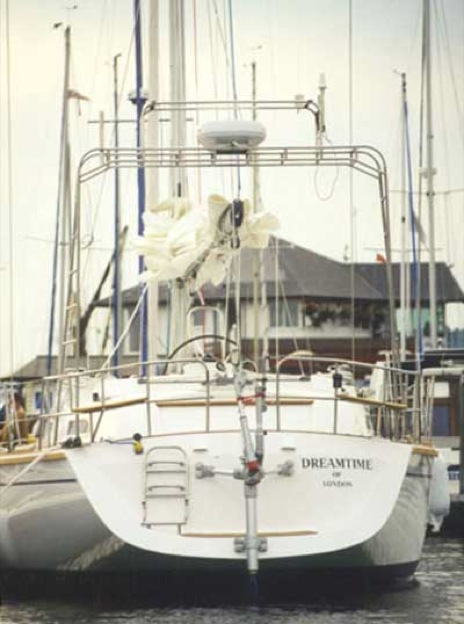
Our windvane uses no electricity to steer the boat. It gets all its power from the wind and the water. That’s a huge advantage for us. Windvanes use the power of the wind and the water going passed the boat to steer. They don’t use any electronics or motors so they don’t need any electricity! Windvanes are a cool bit of engineering that I won’t explain here but I’ll include some links below for anyone that wishes to explore the topic further.
Our windvane is a Windpilot Pacific Plus. It was purchased by Cambria’s original owners and it’s still going strong! It’s in great condition which is amazing considering how tough the marine environment is on mechanical systems. We’re always fixing things but not our Windpilot!
When we bought Cambria the windvane was not installed. Some parts were in storage onshore and some were stored inside the boat. We began gathering the windvane’s bits and pieces and sorting out how they would all go together. Neither Sharlene or I have ever used or installed a windvane so the task was a bit of a challenge. It was a bit like putting together a jigsaw puzzle. Similar to assembling a jigsaw puzzle, it helps to have a picture of the final product to use as a guide. For this picture I went to Windpilot’s website to find product manuals and other information. Even with these manuals I had questions so I emailed their customer support for help.

Windpilot is a small company based in Germany. I sent my questions on a Sunday night and by the time I got up Monday morning I had a reply from Peter Foerthmann the owner, chief designer and engineer for the company. Not only did Peter answer my questions but he suggested I send him photos of our windvane and the various parts I found on board. He would then make suggestions for prepping the windvane before we remounted it on Cambria.

Once we had gathered all the pieces, we found we were missing one mounting bracket. Peter sent the part from Germany. Recently I’ve emailed Peter with questions regarding the windvane and he has always responded within a day. Other than the one part, he didn’t make any money from us. I find it amazing that he is still offering customer support on a piece of equipment he sold more than twenty years ago. Peter’s level of support is exemplary.
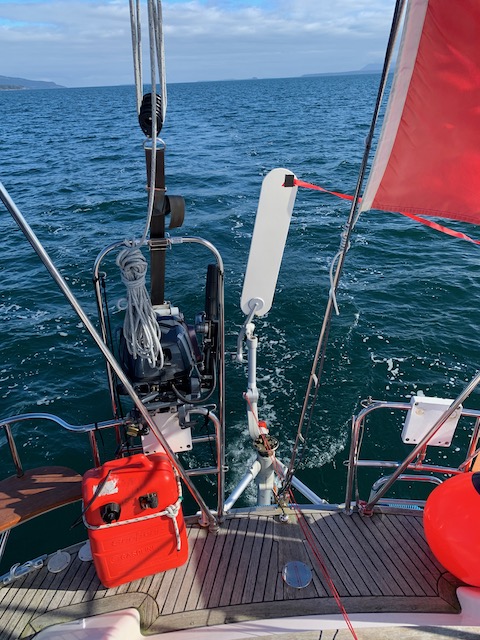
Our Windpilot vane is now back where it belongs–mounted on Cambria’s stern. Last week we took advantage of some unseasonably warm weather and enjoyed a few days of sailing in the Gulf Islands. It gave us a chance to try out the vane. It was the first time we’ve sailed with one and I was surprised at how easy it was to use. Winds were light but we had no trouble setting and keeping the course we wanted. I can hardly wait to get back on the boat and use the vane in stronger winds.
Our self steering systems are vital to us. With only two of us on board they are like having an extra crew member. In fact, they are so important on boats that many people give their autopilots or windvanes a name. We call our autopilot, Otto. I’m sure lots of people call their autopilots Otto but after living most of our lives internationally, it seems fitting to have a multinational crew. We don’t have a name for our windvane, yet. We’ll have to sail with it and get to know it a bit more before we settle on a name. Right now, I’m thinking Carly. We’ll see if it sticks.
Links
Sailing With a Windvane – Cruising World Article
How to Set Up a Windpilot – YouTube video showing a Windpilot windvane in action. It’s not the same model as ours but it shows how windvanes work.


That was very enlightening sounds like a well thought out and engineered piece of equipment.
LikeLike
It is for sure.
LikeLike