
This passage was tougher than I’d anticipated. It shouldn’t have been or so I thought. After all, we had completed the passage from Mexico to the Marquesas–probably the longest passage we’ll ever have to complete. Our passage from Mexico was a little under 3,000 nm (5,000 km). This one was just over 400 nm (740 km). How tough could it be? But it was tough and it was tough for a few reasons.
First, waiting. I had been keeping an eye on the weather for several weeks prior to the trip. There wasn’t much wind. People told us it was unusual to have such light winds. I figured that once the winds kicked in, they would be consistent. So we waited. We altered our plans. We spent more time exploring Nuku-Hiva. We enjoyed the time. When we saw in the forecast that the weather looked good in four or five days, we crossed over to the island of Ua-Pou so we’d be ready to go.
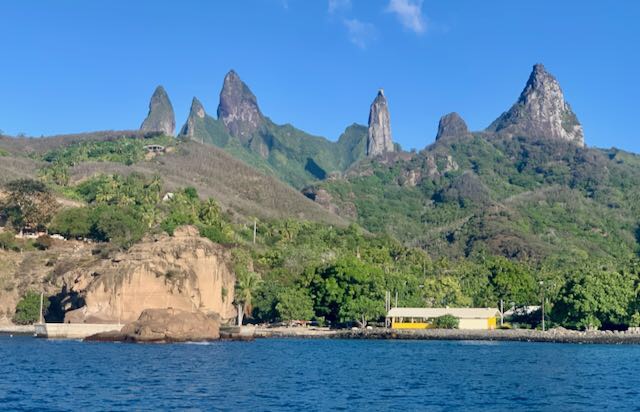
Ua-Pou was great. We hiked. We discovered our favourite waterfall. We hung out with our friends on Renard. We spent several more days on Ua-Pou than we’d planned. Each morning I’d download a weather report. Each day it showed that the weather looked good to go in two days time. The next morning when I downloaded the weather report, it looked good to go in two days time. It was always the same. It consistently looked good in two days time. So we waited. Not everyone waited.
A few boats left knowing that the winds would be very light. We chatted with them on the radio each evening and heard that they had less than five kts of wind and were travelling at less than three kts of boat speed. For us, that would mean banging. When the winds are very light, there isn’t enough wind to keep our sails filled. Each time a wave hits, it knocks the wind out of our sails. The lines slack. When the sails fill again, the lines go tight and everything bangs. It’s not good for the rig. It’s hard on our nerves. We don’t like banging. We were glad we were still on Ua-Pou.
Eventually, we got a better weather forecast. When doing my regular morning weather check, the forecast looked okay for the next morning. Winds would be light for the first day but they’d be sailable. We made the boat ready for the passage. That afternoon I downloaded an updated forecast. It wasn’t as good as the morning’s forecast. It had changed. The weather looked better two days out. The forecast for the next day wasn’t terrible. It wasn’t as bad as some of the previous ones we’d seen. The winds would be quite light but sailable or so we hoped. We decided to go.
We got up and were underway shortly after daybreak. Two boats we’d been waiting with were already underway by the time we left. As we pulled up the anchor we motored passed a catamaran. The skipper came out on deck and asked where we were going. I told him the Tuamotus and he said, “but there’s no wind!” He was right. We motored out of the bay and continued to motor off and on for the next day and a half.
We were trying to time slack tide at the entry pass to get into Raroria. We thought if we just motored another few hours, the winds would fill in and we’d make the slack. It didn’t work that way. Eventually our thinking changed to, “we’ve motored this long now. We’d better keep motoring or all this motoring will have been a waste of time and fuel.” It was a waste of time and fuel.
This winds didn’t fill in for days. We eventually stopped motoring. We decided we’d get to Raroia when we got to Raroia. We’d worry about slack tide at the entry pass when we got closer to it. Later, the winds did fill in and they filled in strong.
On our third night I had the midnight to 03:00 watch. At the start of my watch we had good consistent winds and were sailing well. By the end of my watch we were experiencing heavy rain squalls and had two reefs in the mainsail and one in the genoa. The rain squalls continued for the next 12 hours but even after they let up, the day was grey, dreary and windy. The winds continued to build through that night and through the next night. It is debated onboard, but it may have been the roughest sailing we’ve done on Cambria to date. The waves were steep and a good three meters high. Winds were in the mid to high 20’s. At one point I saw 32 kts apparent. The wind direction had moved around so we were fighting upwind in order to get to Raroia. Cambria slammed down on waves making the hole boat shudder. Waves would crash against the hull sending plumes of spray crashing over the cockpit. There wasn’t a dry spot in cockpit. We sat tucked in under the dodger which protected us from the crashing waves but the water managed to seeped along the seats and find us. I took to wearing my bathing suit as there was no way I could keep my clothes dry.
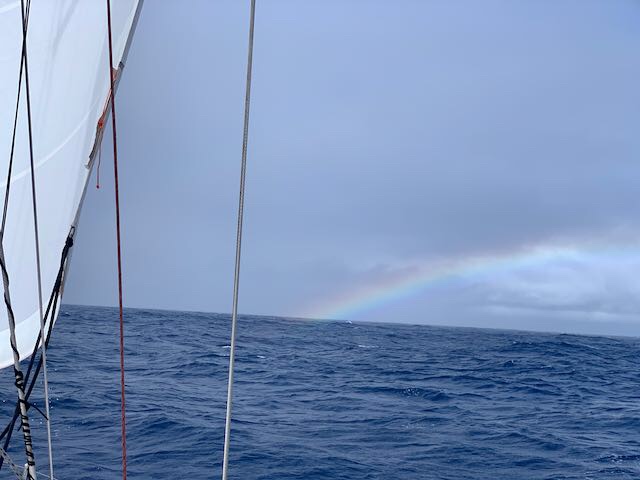
First thing on the morning of our fourth day, our friends on Renard texted us. The were 50 – 60 nautical miles (90 – 110 km) behind us. They were not going to be able to make Raroia without tacking back up wind. We weren’t going to make it either but had assumed we’d tack our way back up to the island. The bigger issue for Renard was that they would arrive at Raroia at least a day behind us. They and we agreed, did not want to spend an extra 24 hours in these conditions. We decided to change our destination to Tahanea Atoll. It was 130 nautical miles (240 km) further than Raroia and meant another night at sea for us but it was in a much better direction for the current winds. An extra night at sea in comfortable conditions seemed much better than the pounding we were enduring. We altered course and headed for Tahanea.
It’s amazing what a difference 20° makes. As soon as we changed course, things became comfortable–even easy. The winds and seas were the same but the boat’s motion was not only tolerable but pleasant. An extra night in this would be no problem. Cambria loved the new sailing angle. If anything, she loved it a little too much. We were cruising at six and a half kts and we were still heavily reefed. After consulting the currents at Tahanea’s entry pass, we realized we would arrive too early for the afternoon slack. In fact, we’d almost make the morning slack if we continued at our current pace. We knew the winds would ease overnight and along with it our speed but still, we’d be many hours early for the afternoon slack. We reefed the sails more but it wasn’t enough. Cambria was on her way!

We passed a very pleasant night. The winds dropped as predicted but we kept up a good turn of speed. As the sun rose we got our first glimpse of an atoll–two actually, Makemo in the distance was to our port and Katiu to our starboard. We continued on and arrived at Tahanea about four hours before slack water.
We heaved-to and waited. The time passed quite quickly. We had lunch, tidied the boat and relaxed while we waited. I even had a nap. We entered the pass half an hour before slack. There was still one to one and half kts of current running against us. It slowed our progress but the pass is not long so we were soon safely out the other side. Shortly after that we were anchored just west of the main pass enjoying a magnificent sunset. Our first in the Tuamotus. Passage done!


Wow, glad you were able to alter course for Tahanea! It sounds like that was a grand adventure! I do not know if i ever told you that heaving to is my most favorite point of sail! Looking forward to some pics of that atoll.
LikeLike
These atolls are so beautiful with crystal clear water. Just amazing.
LikeLike
Finally got some photos of Tahanea posted. I bet Gracenote heaves-to really well. We have to work at it. We forereach more than heave-to.
LikeLike
Hey; nice description of your passage. Not much fun for a while but hats off to the skipper and crew for gutting it out and then making the key decision to change destination and course.
Life on the ocean is not set on paper , nor is it a straight line.
Good one.
LikeLike
Thanks!
LikeLike
Well done! Exciting description of your passage! 🙂
LikeLiked by 1 person