
We have recently installed a hooka system onboard. For those that aren’t familiar with hooka systems, they aren’t to be confused with hooka pipes. A hooka system consists of an air compressor that pumps air down a hose to a diver. Our system consists of a small electric compressor connected to a 14m hose. At the end of the hose is a dive regulator. We power the compressor by connecting it to our house battery bank. The cables are long enough that the compressor can sit on deck with the power cables reaching down into the main salon.
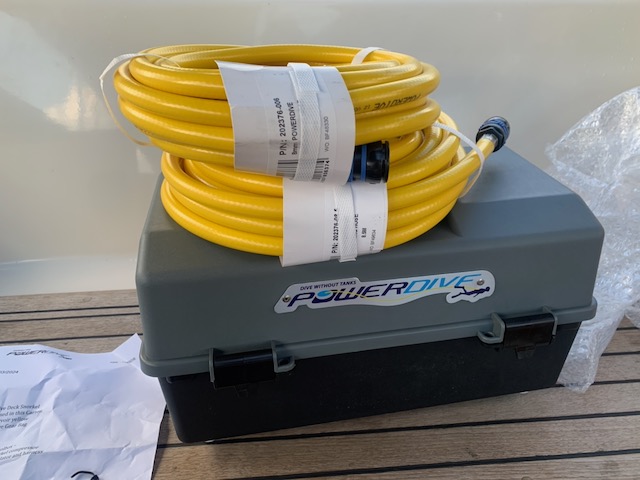
We purchased our hooka so we can work on the hull. Mainly, we need it for scrubbing the bottom. I mentioned in an earlier post that a friend compares needing to scrub the bottom of his boat to a homeowner needing to cut his/her lawn. We don’t have to scrub the hull as often as we used to mow our lawn but we do have to do it every few weeks. If we don’t, the growth gets harder to get off and we sail noticeably slower.
We have scuba gear onboard and previously that is what I used to clean the boat but it wasn’t ideal. Scuba gear is great when one is several meters below the ocean’s surface but when one is working at the surface or just a few meters below the surface, it is cumbersome. Also, we found it difficult to get our tank filled. In most places we were able to plan ahead and get it filled as we moved along but in New Zealand, no one would fill it. New Zealand did not recognize its certification and we couldn’t get it certified–we tried. That’s why we decided to take the plunge and get a hooka system. The system won’t be good for diving but it is quick and easy to set up for routine cleaning and maintenance on Cambria.
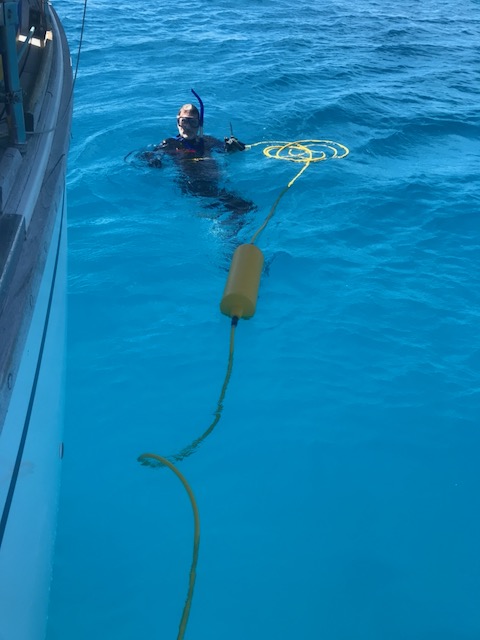
We know one boat that made their own hooka system. It’s not difficult but with everything else we had to do in our last weeks in New Zealand, we decided to buy a Deck Snorkel. Over the last couple of years I have tried a couple of hooka systems and frankly, I didn’t like them. When scrubbing, I found I would outbreathe them. I would often have to pause what I was doing to catch my breath. They couldn’t supply me with the air I needed. The Deck Snorkel is different. It has a small tank built into the delivery hose. The tank is like a buffer. If on occasion I need more air than the compressor can deliver, there is extra air in the tank. I have used our new hooka system several times and so far, I have not outbreathed it. I assume it’s because of the tank but I don’t know. I just know that it gives me all the air I need.
I should note that the bottom paint we had put on in New Zealand is much better than what we used the year before. I am not having to scrub the hull nearly as often. I’d like to not have to scrub it at all but at least when it does need a scrub, I now have an easier way to do it.
 Cormacks On Cambria
Thank you for the info on difficulty filling diving tanks in NZ and your solution with the Deck Snorkel. We’ve been managing to keep the bottom and prop clean with free-diving and occasional use of a scuba tank. We found that hanging a long line on each side of the boat helps maintain one’s place along the hull if there’s a current. We’re curious to know what bottom paint you put on the hull in NZ. Did you go with a silicone paint, and did you apply it yourself?
LikeLike
Hey there, we have also hung a line along the hull to help us stay in place. Also, I sometimes use a short plunger like one might use to unclog a sink. It sticks to the hull quite well.
In NZ, we used Pettit Hydrocoat. We did not apply it ourselves. We did a bunch of jobs ourselves when we were hauled out but not the antifouling.
LikeLiked by 1 person
what an excellent blog. So well researched and written. Thank you. I thought about buying one for our boat, for when we return to Mexico in October. But so far haven’t been able to figure out how to buy the system for Amazon delivery to Mexico.
Best, Scott
LikeLike
Thanks and didn’t figure out Amazon shipping to Mexico when we were there.
LikeLike